
Guides
Non-woven Arm Sleeves: Where Breathable Sleeve Covers Belong
15 July 2026 · 4 min read · Disponord
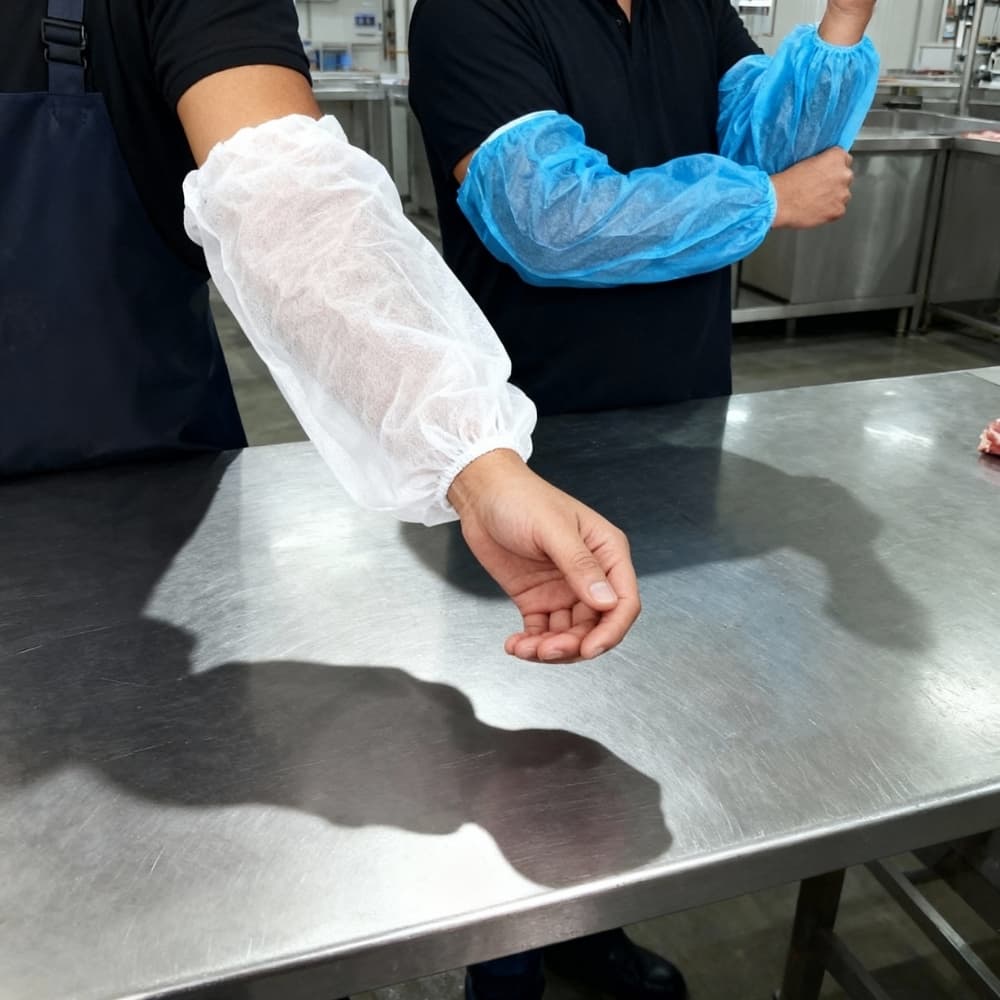
The gap between glove and sleeve is a real contamination route. Here's why breathable non-woven arm sleeves are the right answer in dry zones — and where they are not.
Key takeaways
- In a dry zone, a sleeve cover's job is controlling fibres from clothing — not repelling liquid.
- Ultrasonic seams remove the needle holes and loose thread ends a stitched seam leaves behind.
- A breathable cover gets worn all shift; an uncomfortable one gets taken off.
Sleeve covers are usually the item specified last and thought about least. They sit in the gap between a glove and a sleeve — a few centimetres of exposed forearm that carries fibres from clothing, picks up product residue, and passes over every surface an operator touches. In a packing hall or a dry handling zone that gap is a genuine contamination route, and closing it costs a few cents per shift. The complication is that not all sleeve covers do the same job: the plastic ones that make sense in a wet butchery are the wrong answer on a packing line. This guide covers what a sleeve cover is actually for, what separates a well-made one from a cheap one, and how to specify by zone rather than buying a single item for the whole plant.
What a sleeve cover is actually for
A sleeve cover does two jobs: it protects the product from the operator, and it protects the operator's clothing from the product. Which one dominates depends entirely on the zone. In wet butchery the second job wins, and the cover has to repel liquid. In dry handling, packing and assembly the first job wins, and the hazard is not water — it is fibres, dust and skin shed from a working arm. That is what breathable non-woven sleeve covers are built to control.
This distinction matters because the instinctive way to specify PPE is to ask which option is tougher, and the answer is always plastic. Ask instead what the hazard in this zone actually is, and most of a food plant turns out to be a non-woven job. Buying polyethylene everywhere is not a safer choice — it is an unexamined one, and it costs you in comfort and compliance in every zone that never needed it.
Why ultrasonic seams matter in food contact
A stitched seam is made with a needle and thread, and in a food-contact garment that creates two problems: perforations along the seam line, and thread ends that can work loose. Both are potential physical contaminants sitting on the operator's forearm, directly over the product. Ultrasonic seams solve this by bonding the fabric with high-frequency vibration instead — no needle, no thread, nothing to shed. It is a small construction detail, but it is the difference between a garment that controls fibres and one that quietly adds them.
It is also invisible in a product photograph, which is why it is worth asking any supplier directly which method they use. Two sleeve covers can look identical in a catalogue and behave differently on a line.
Breathability and the full-shift problem
An operator on a packing line wears a sleeve cover for hours, not minutes. Polyethylene does not breathe: arms sweat, the cover becomes uncomfortable, and at some point it comes off — usually without anyone recording that it did. Comfort in this context is not a nicety, it is a compliance question. The most effective piece of PPE is the one people keep wearing.
Non-woven spunbond fabric breathes, which is why it holds up across a full shift where plastic does not. Elastic at the wrist and the upper arm keeps the cover in place through repetitive movement rather than riding down towards the glove, and the fabric is hypoallergenic, so it stays tolerable against bare skin hour after hour.
Where non-woven belongs — and where it does not
The useful habit is to map the covering to the zone, then standardise it. A rough guide for a typical food operation:
- Packing, assembly and dry handling — non-woven; long shifts make breathability the deciding factor
- Dairy filling and dry-goods lines — non-woven; the hazard is fibre and dust, not liquid
- Butchery, evisceration and washdown — PE; only a waterproof cover survives repeated contact
- Chilling, brining and raw handling — PE; liquid and cold rule out breathable fabric
- Visitor and short-duration access — non-woven; worn for minutes, comfort and cost both favour it
Most plants run both materials, and that is the correct outcome rather than a failure to standardise. Our waterproof PE sleeve covers are the counterpart for wet stations, where they are normally specified alongside PE aprons as a set. In dry zones, non-woven sleeves pair naturally with hair nets and non-woven shoe covers as part of a single defined kit.
Specifying and resupplying
Once the zone map is set, two things keep it working. The first is colour: assigning a colour to each zone makes a breach visible across the room, and sleeve covers are available in white and blue for exactly this reason. The second is resupply. A defined kit is only as good as the box on the shelf — if a line runs out of sleeve covers on a Friday afternoon, the rule gets skipped, and the specification you spent time on stops describing what is happening on the floor.
Disponord manufactures and exports single-use hygiene consumables suitable for HACCP-controlled environments, supplying food processing, packing and dairy operations in bulk with one consistent specification across sites. If you would like help mapping sleeve covers and the rest of a kit to your zones, or a sample set to evaluate on a line, send us your requirement and we will come back with options and a quote.
Frequently asked questions
- What are non-woven sleeve covers used for?
- They cover the forearm between glove and sleeve in dry food handling, packing and assembly work, where the main hazard is fibres and debris shed from clothing rather than liquid. They are also widely used in dairy and dry-goods lines and for short visitor access, because the breathable fabric is comfortable enough to wear for a full shift.
- Are non-woven or PE sleeve covers better for food processing?
- Neither is better overall — they answer different hazards. Non-woven is breathable and suits dry handling, packing and long wear. PE is waterproof and is the right choice for butchery, evisceration, washdown and chilling. Most plants specify both and assign each to defined zones.
- What are ultrasonic seams and why do they matter?
- An ultrasonic seam bonds the fabric using high-frequency vibration rather than a needle and thread. That removes the perforations and loose thread ends a stitched seam leaves behind, both of which are possible physical contaminants when the garment sits directly over exposed product.
Related products
- Arm Protection
PE Sleeve Covers
Waterproof polyethylene sleeve covers with elastic cuffs — for food handling and wet processing zones in meat, seafood and dairy plants.
View product → - Arm Protection
Non-woven Sleeve Covers
Breathable non-woven sleeve covers with ultrasonic seams and elastic cuffs — for food handling, packaging and dry processing zones.
View product → - Body Protection
Disposable PE Aprons
Lightweight waterproof polyethylene aprons for food handling and wet processing — knee-length coverage for meat, dairy and packaging zones.
View product →
Need disposable PPE for your facility?
Send us your requirement and we'll get back to you with a quote.
Request a Quote