
Guides
Beard Nets in Food Processing: When Beard Covers Are Required
20 July 2026 · 4 min read · Disponord
A hair net stops at the hairline. Here's when a beard net is required in food processing and food service, and how to specify a beard cover that stays on.
Key takeaways
- A hair net covers scalp hair only — a beard net closes the gap facial hair leaves open.
- Beard nets are a per-shift consumable; breathability decides whether staff keep them on.
- Specify by bearded headcount, not by the box — running short is what breaks compliance.
A hair net stops at the hairline. For anyone with a beard, that leaves the single most visible source of loose hair completely uncovered — and it is exactly what a food-safety auditor tends to look at first. Beard nets close that gap, and in most meat, poultry, dairy and prepared-food operations they are not optional for bearded staff. This is a short guide to when they are required, how they differ from a hair net, and how to specify beard nets so you order the right thing and never run short.
Why a hair net is not enough
Head coverings and beard coverings solve two different problems. A hair net or bouffant cap contains scalp hair; it does nothing for a beard. Facial hair sheds the same way scalp hair does, and it sits directly over the workspace — over the cutting board, the conveyor, the open product below. In a physical-contamination hazard analysis an uncovered beard is a clear route for foreign material, which is why a plant that enforces hair nets rigorously but ignores beards is only half covered. Enforcement tends to drift here precisely because a beard feels like a smaller detail than a full head of hair, but to an auditor an uncovered beard over an open line is the same finding as an uncovered head. Put simply: if a role requires a hair net, the same logic requires a beard cover for anyone with facial hair.
Food processing and food service both need them
Beard covers are usually associated with heavy processing — meat, poultry, fish, dairy — where full hygiene gowning is already standard. But the same requirement runs through food service and catering kitchens, where a bearded chef or line cook works just as close to open food. The context differs: a processing plant issues them at a gowning station as part of a fixed kit, while a kitchen may simply keep a box at the entrance for staff and visitors. The commonly missed case in both settings is the short visit — a bearded contractor, engineer or auditor who steps onto the floor for ten minutes carries the same hazard as a full-time operator, so the entry point needs covers on hand for them too. The product is the same; what changes is how you distribute and reorder it.
What to look for in a disposable beard net
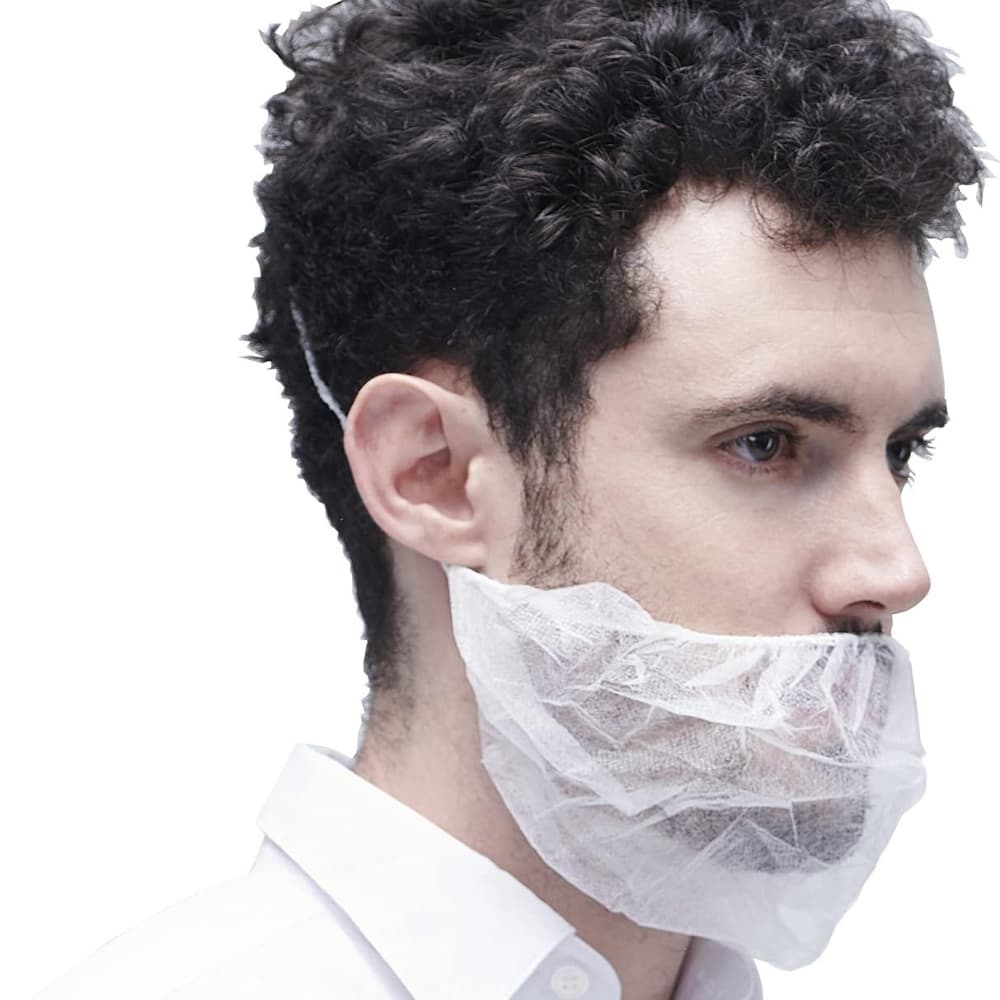
Most disposable beard covers are made from light non-woven spunbond fabric with a single elastic loop that hooks over the ears and holds the cover against the jaw. Beyond that, a few things separate a cover people keep on from one they pull down:
- Breathability — a beard cover sits against the skin, and an airless one gets tugged below the chin within the hour.
- A secure single-loop fit that holds while an operator talks and moves, without pinching.
- Hypoallergenic fabric, since it is in constant contact with the face.
- Consistent sizing across a bulk order, so every operator gets the same fit shift after shift.
Beard cover, beard net or beard snood?
These terms describe the same product. 'Beard cover' and 'beard net' are used interchangeably, and 'beard snood' is the more traditional name. 'Beard mask' is sometimes used loosely, but a beard cover is not a filtering face mask and does not replace one where a face mask is required. If a supplier lists any of these, ask about the fabric weight and the fit rather than the label on the bag — that is what actually decides whether the cover works over a full shift.
How to specify and reorder
Beard nets are a per-shift consumable: roughly one per bearded operator per shift, plus spares for visitors and changeovers. The most common reason a plant slips out of compliance is not policy — it is running out, because the order was based on a round number rather than actual headcount. Count your bearded staff, add a visitor and contractor allowance, and set a reorder point that survives a busy week. If you are building or refreshing a hygiene kit and want beard covers matched to the rest of your head-and-face protection, we can help you specify by zone and set up reliable bulk resupply.
Frequently asked questions
- Do you still need a beard net if you wear a hair net?
- Yes. A hair net covers scalp hair only and does nothing for a beard. Anyone with facial hair working near open food needs a beard net in addition to a head covering, because facial hair sheds the same way and sits directly over the product.
- Are beard covers required in food service kitchens?
- Wherever staff with beards work close to open food, the same hygiene logic applies as in a processing plant. Many catering and food service operations require beard covers for bearded kitchen staff, and food-safety audits routinely check for them.
- What are disposable beard nets made of?
- Most are light non-woven spunbond fabric with a single elastic ear loop. The fabric is breathable and hypoallergenic so it can sit against the skin for a full shift — breathability is the main thing that decides whether staff keep it on.
Related products
- Head Protection
Disposable Hair Nets
Non-woven bouffant caps with double elastic band for food processing — breathable, hypoallergenic, controls hair contamination in production and packaging zones.
View product → - Face Protection
Disposable Beard Covers
Single-use non-woven beard covers with a single elastic loop — for food processing, meat plants and food service kitchens.
View product → - Face Protection
3-Ply Face Masks
3-ply disposable masks with meltblown filter layer. Ear-loop, white or blue. Bulk supply for medical, food and industrial use.
View product →

Need disposable PPE for your facility?
Send us your requirement and we'll get back to you with a quote.
Request a Quote