
Products & specs
Disposable PE Aprons: Thickness, Length and How to Specify Them
16 October 2026 · 4 min read · Disponord
Micron, length, width and packing: what to put in a PE apron specification so a food plant gets an apron that survives the task without overpaying.
Key takeaways
- A PE apron specification needs four numbers: thickness in micron, length, width and pieces per carton.
- Thicker is not always better: a heavy apron costs more per piece and is hotter to wear, so match thickness to the task, not to the worst case.
- Ask every supplier for a sample and test it on the actual task before agreeing a bulk order.
Waterproof disposable aprons look identical in a catalogue until they are on a worker at the end of a wet shift. Some tear at the neck loop, some are too short to protect the thighs, and some are so thick that staff take them off. Most of these problems start with an incomplete enquiry. This guide covers what a PE (polyethylene) apron specification should contain, how thickness, length and width relate to the task, and what to ask a supplier before ordering in bulk.
What a disposable PE apron is for
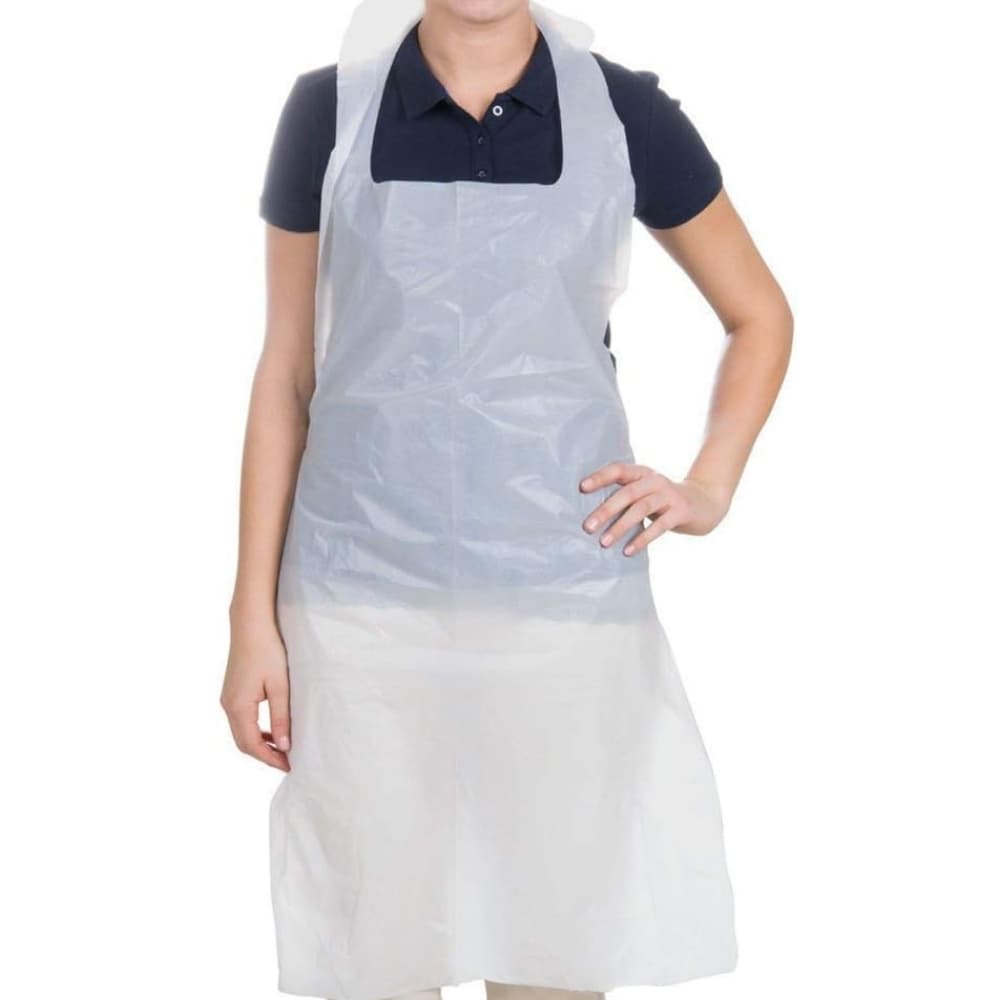
A PE apron is a waterproof barrier between the worker's clothing and wet product, blood, brine or washdown water. It protects the front of the body only, which is why it is cheaper and cooler than a coverall. It is used in meat, poultry, fish, dairy and general food handling wherever splash and contact are the main concern, and it is worn once and discarded at the zone boundary.
Thickness: what micron really tells you
Thickness is quoted in micron (one micron is a thousandth of a millimetre). It is the single biggest driver of strength, price and comfort. Exact ranges differ between suppliers, so treat the table below as a way to think about the choice, not as a standard.
| Task | Thickness approach | Why |
|---|---|---|
| Short tasks, visitors, light splash | Lightweight film | Lowest cost per use, easy to dispense in volume |
| Standard line work, wet product contact | Medium film | Balance of tear resistance and comfort over a full shift |
| Heavy wet work, fish, slaughter, washdown | Heavier film, often with a longer cut | Resists tearing and soaking through during hard use |
Heavier film resists tearing but is stiffer and warmer. If staff remove aprons because they are uncomfortable, the control fails regardless of thickness. Test the apron at the temperature and pace of the real task.
Length and width
- Knee-length aprons suit standing work at a table or conveyor where splash lands on the torso and upper legs.
- Ankle-length (long) aprons suit fish, seafood and heavy wet zones where water runs down the legs and onto footwear.
- Width matters as much as length: a narrow apron leaves the sides of the torso exposed when the worker turns.
- Check the full size range if your workforce varies in height; one length rarely fits everyone.
Format, colour and packing
Aprons are supplied flat-packed in bags or cartons, and some formats use a tear-off neck and waist tie for fast donning. Agree how the apron is dispensed in your plant, because the format affects how quickly it can be put on and how much storage it needs. Blue and white are the usual colours; blue contrasts better with most food products, and a colour that matches your zone code makes a worker in the wrong area visible at a glance. Specify pieces per bag and bags per carton so dispensers, stock rotation and pallet loading work.
What to ask a PE apron supplier
- What is the thickness in micron, the length and the width of each model?
- What colours are available, and are they consistent from batch to batch?
- How is the apron packed, and how many pieces are in a carton?
- Can you send samples so the apron can be tested on the real task?
- What is the typical lead time, and what are the order quantities for standard and customised items?
Common mistakes when ordering PE aprons
- Ordering on price per piece without checking thickness, so the cheapest apron tears at the neck loop or the side tie within an hour.
- Choosing one length for the whole plant, which leaves shorter staff tripping on long aprons and taller staff exposed at the knee.
- Ignoring the dispensing format, so aprons are slow to put on and staff take two or three at a time.
- Skipping the sample stage and discovering a problem only after a full pallet has arrived.
- Forgetting to match colour to the zone code, which makes the apron useless as a visual control.
PE apron or non-woven apron?
If the task involves liquid, a PE apron is the right choice because the film does not let water through. If the task is dry, such as packing, bakery work or visitor routes, a non-woven apron is usually more comfortable because it breathes. Many plants stock both and assign them by zone, which keeps the specification simple: wet zones get PE, dry zones get non-woven. The difference is covered in more detail in our guide to PE versus non-woven disposable PPE.
Disponord supplies disposable PE aprons and PE long aprons for food processing in bulk. Send us your task, zone and expected monthly volume and we will propose a specification and sample options. Typical delivery is 7 to 21 days in total, production and shipping together, depending on the item and destination.
Browse all products & specs guides →
Frequently asked questions
- What thickness should a disposable PE apron be?
- It depends on the task. Light film is enough for visitors and short, low-splash tasks. Standard line work with wet product usually calls for a medium film, and heavy wet zones such as fish or slaughter benefit from a heavier film. Test samples on the actual task before ordering in bulk.
- Are PE aprons waterproof?
- Yes. Polyethylene film is waterproof, which is why PE aprons are used where wet product and washdown water are present. Non-woven aprons are more breathable but are not a waterproof barrier.
- Can I order PE aprons in my own colour or length?
- Colour and size options depend on the model and the order quantity. Send your specification and volume with your quote request and we will confirm what is possible.
Related products
- Body Protection
Disposable PE Aprons
Lightweight waterproof polyethylene aprons for food handling and wet processing — knee-length coverage for meat, dairy and packaging zones.
View product → - Body Protection
Disposable PE Long Aprons
Ankle-length waterproof polyethylene aprons for maximum coverage in seafood, fish and heavy wet food-processing environments.
View product →

Need disposable PPE for your facility?
Send us your requirement and we'll get back to you with a quote.
Request a Quote