
Industry guides
Disposable PPE for Egg Packing and Egg Processing Plants: What to Issue in Each Zone
17 October 2026 · 4 min read · Disponord
From wet washing and grading to breaking rooms and dispatch: a zone-by-zone guide to disposable hygiene PPE for egg packing and egg product plants.
Key takeaways
- Egg plants combine wet, messy zones with clean packing zones, so PPE must change at each boundary, not only at the main entrance.
- Waterproof PE aprons and boot covers suit washing and breaking rooms; lighter hair and beard covers suit grading, packing and dispatch.
- Separating raw and finished areas works only if each side has its own stock, its own colour and its own disposal point.
- Plan volume per zone and per shift, then add visitors and contractors, because PPE turns over quickly in egg plants.
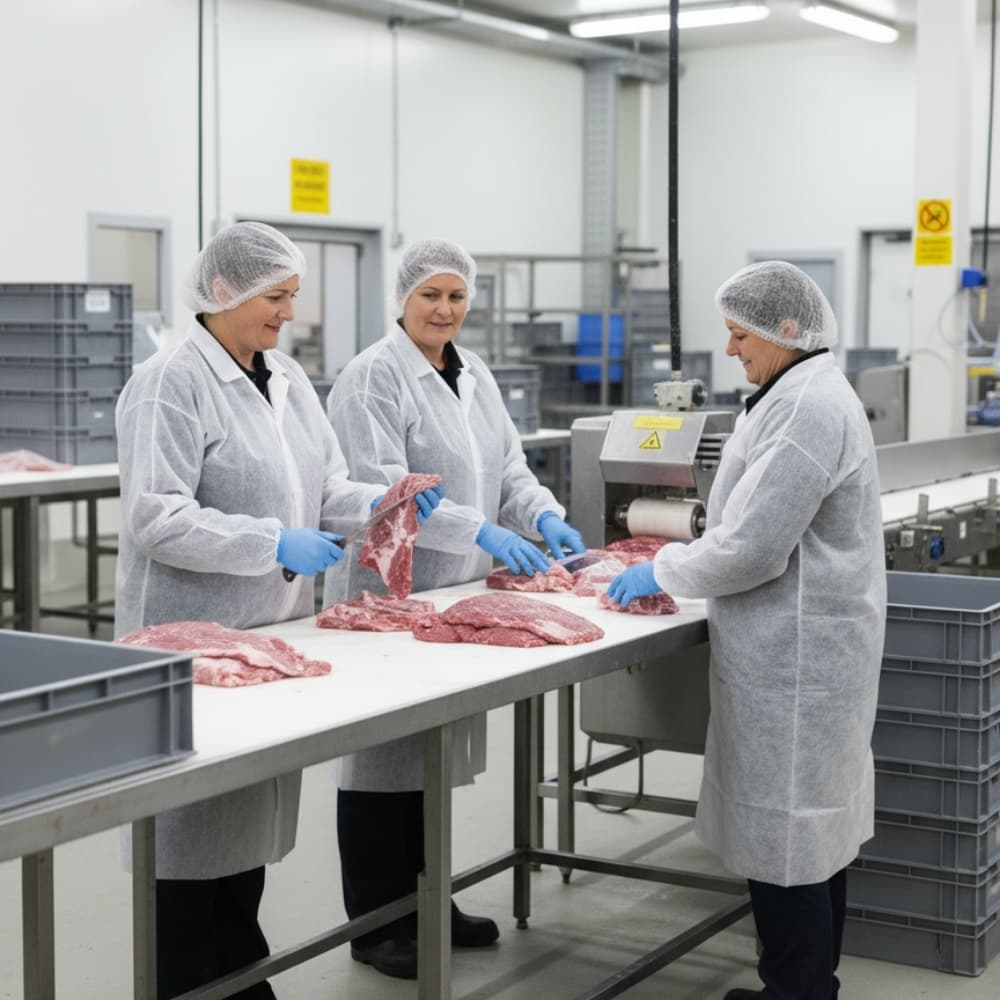
An egg plant is two environments under one roof. Shell eggs arrive with dirt, moisture and handling traces, while graded and packed eggs, or liquid egg product, must stay clean until dispatch. Disposable PPE is one of the simplest ways to hold that line, because every garment is issued at a boundary and thrown away at the next. This guide covers hair, beard, apron, sleeve and footwear items for egg grading and packing plants and for egg breaking and egg product processing. Gloves are out of scope here.
Why egg plants need zone-based PPE
Wet washing, candling, breaking and liquid product handling each create a different exposure. A single set of garments worn from intake to dispatch carries soil forward. Zone-based PPE breaks that chain: staff change aprons, boot covers or sleeve covers when they cross from a dirty side to a clean side, and the used items stay behind. It is also easy to explain to an auditor, since the control is visible on the floor.
Separating raw and finished areas
Separation is more than a painted line. Plants that manage it well tend to use the same simple rules.
- Give each side its own PPE stock, stored where it cannot be reached from the other side.
- Use a different colour for the raw side and the finished side, so a wrong garment is spotted immediately.
- Place a disposal bin at every crossing point, and require removal of aprons and boot covers before passing.
- Keep a clear route for staff, so nobody walks from breaking to packing without changing.
- Treat trolleys, crates and tools with the same logic as people.
Zone-by-zone PPE guide
The table below is a starting point. Adjust it to your layout, your product and your own audit scheme.
| Zone | Typical disposable PPE | Notes |
|---|---|---|
| Intake and wet washing | Hair net, PE apron, boot covers, sleeve covers | Waterproof items for spray and splash; change before leaving the zone |
| Candling and grading | Hair net, beard cover where needed, non-woven sleeve covers | Light items for long wear; keep clear of wet-side garments |
| Breaking room | Hair net, beard cover, PE apron, PE sleeve covers, boot covers | Highest splash exposure; replace aprons as soon as they are soiled |
| Liquid egg and product handling | Hair net, beard cover, apron, sleeve covers | Stricter changing rules, usually a separate colour |
| Packing and palletising | Hair net, beard cover where needed, sleeve covers | Clean zone; no garments from the wet side |
| Dispatch and loading | Hair net, boot covers for visitors and drivers | Control of outside traffic matters more than extra layers |
What to specify for each item
- Aprons: PE film, with thickness, length and width stated in the order. Heavier film for breaking rooms, lighter film for short tasks.
- Boot covers and shoe covers: waterproof PE for wet floors, non-woven where grip and breathability matter more.
- Hair and beard covers: size, elastic quality and colour, stated clearly in the order.
- Sleeve covers: PE where splashes are likely, non-woven for long packing shifts.
- Packing: pieces per bag and per carton, so staff and stores can count stock quickly.
Handling visitors and contractors
Visitors, maintenance staff and drivers are a recurring risk in egg plants, because they move between zones without a fixed routine. Issue a hair net, a beard cover where relevant, a visitor gown or coverall and boot covers at the entrance, brief them on the route, and collect everything at the exit. Keep a separate stock for this group, so production supplies are not drained by tours and repairs. Note the issue and return counts on busy days, so you can see how much a tour or a repair really uses.
Planning volume
Estimate consumption per zone and per shift, and use your own figures. Start from headcount, then multiply by the number of changes per person per shift.
- Count staff per zone per shift, including agency and relief staff.
- Set how many times each item is changed per shift: hair covers once, aprons and boot covers at each crossing.
- Add visitors, contractors and audit days.
- Add a safety margin for tears, spills and peak production periods.
- Convert the total to cartons, then plan orders around your lead time.
Disponord manufactures and exports disposable hygiene PPE for food plants. Request a quote on the website with your zones and monthly volumes; delivery is typically 7 to 21 days in total, production and shipping combined.
Frequently asked questions
- Do shell egg packing plants need the same PPE as egg breaking plants?
- Not exactly. Breaking rooms have more splash and liquid contact, so they usually need waterproof aprons, sleeve covers and boot covers. Grading and packing mainly need hair covers, beard covers and light sleeve covers. Check your own audit scheme and local rules.
- How do we keep raw and finished areas separate with PPE?
- Use separate stock, a different colour on each side, a disposal bin at every crossing and a fixed staff route. Remove aprons and boot covers before passing from the raw side to the finished side.
- Which PPE do visitors need in an egg plant?
- A hair net, a beard cover where relevant, a visitor gown or coverall and boot covers are the usual set. Issue them at the entrance and collect them at the exit.
- How do we estimate how much PPE an egg plant uses?
- Count staff per zone and shift, multiply by the number of changes per item, add visitors and a safety margin, then convert to cartons. Use your own figures, not general averages.
Related products
- Head Protection
Disposable Hair Nets
Non-woven bouffant caps with double elastic band for food processing — breathable, controls hair contamination in production and packaging zones.
View product → - Face Protection
Disposable Beard Covers
Single-use non-woven beard covers with a single elastic loop — for food processing, meat plants and food service kitchens.
View product → - Foot Protection
Disposable Boot Covers
Waterproof polyethylene boot covers (anti-slip sole option) for slaughterhouses and wet food plants — full lower-leg coverage, bulk packaging for facility use.
View product → - Body Protection
Disposable PE Aprons
Lightweight waterproof polyethylene aprons for food handling and wet processing — knee-length coverage for meat, dairy and packaging zones.
View product →

Need disposable PPE for your facility?
Send us your requirement and we'll get back to you with a quote.
Request a Quote