
Food Safety
Choosing the Right Disposable PPE for Meat Processing Plants
10 July 2026 · 3 min read · Disponord
A practical look at how hair nets, aprons, sleeve covers and boot covers work together to control cross-contamination on meat and poultry lines.
Key takeaways
- Single-use PPE is one of the simplest hygiene controls on a meat line.
- Match each product to its zone — dry handling versus wet, high-care versus low-care.
- Consistent specification and reliable resupply matter more than any single feature.
Meat and poultry processing runs on tight hygiene discipline. Product moves fast, temperatures are controlled, and every person on the floor is a potential route for physical and microbial contamination. Single-use protective equipment is one of the simplest and most cost-effective ways to keep that route under control — a clean barrier at the start of every shift, with none of the laundering and inspection overhead of reusable garments. This guide walks through the core disposable products used on a meat line and, more importantly, where each one belongs, so you can specify a complete kit by zone rather than buying items piecemeal.
Why disposable PPE matters on a meat line
Reusable workwear has to be collected, laundered, validated and redistributed — and every one of those steps is a place where a garment can pick up or carry contamination. Single-use items remove that variable entirely. Each operator starts the shift with a fresh, uncontaminated barrier, and when it is removed it leaves the clean zone for good. In practice this makes hygiene easier to enforce and easier to audit: there is no ambiguity about whether a garment was cleaned correctly, because it is never reused.
The other advantage is speed of response. If a line has an incident — a spill, a dropped product, a visitor entering a high-care area — replacing a disposable item takes seconds and costs cents. That low switching cost is exactly what you want when the alternative is a contamination risk on a food product.
Head and facial hair control
Loose hair is the most visible contamination hazard in any food plant, and it is the first thing an auditor looks for. Bouffant caps cover the full head with a gathered, double-elastic fit that holds over longer hair and across a full shift. For staff with facial hair, beard covers close the second obvious gap. Match the cap size and weight to the zone: a heavier, larger bouffant for production staff who wear it for hours, a lighter net for short visitor access.
Wet-zone protection
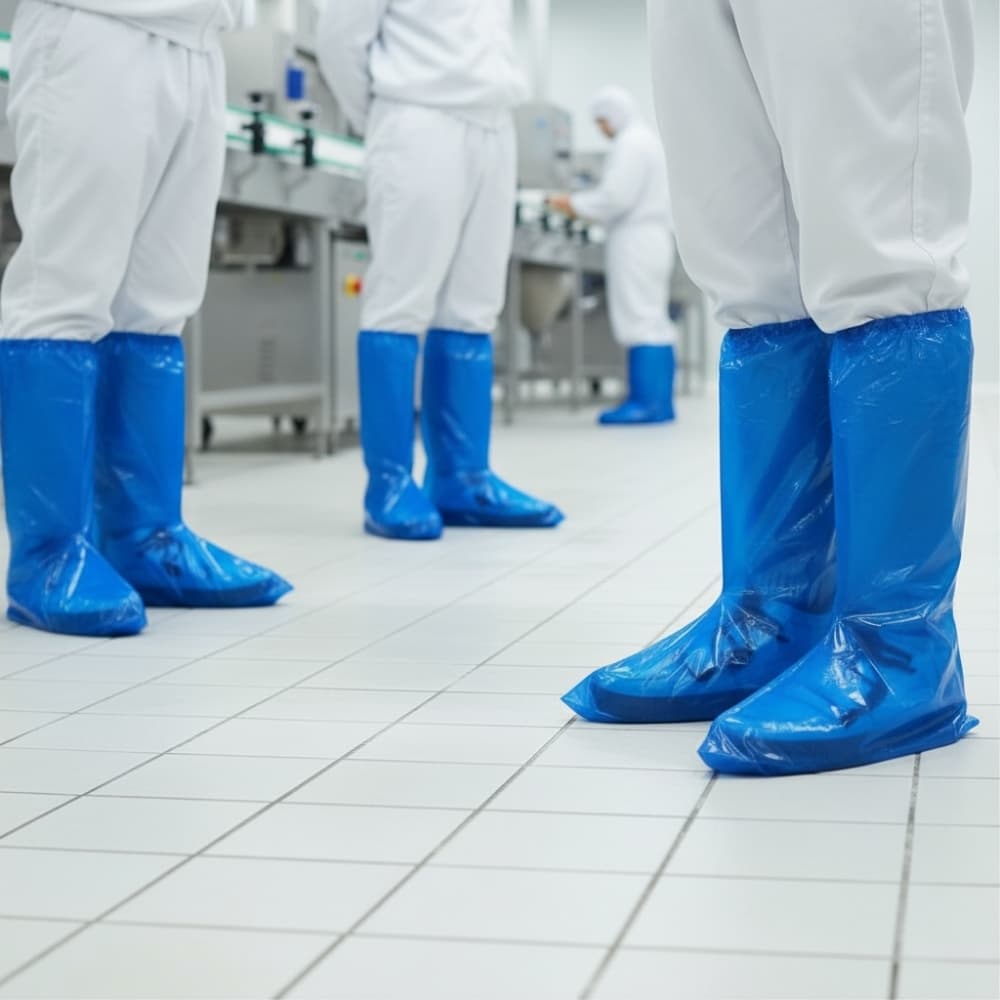
Butchery, evisceration, washdown and chilling areas are wet, and standard workwear soaks through quickly. Waterproof polyethylene aprons keep operators dry through repeated contact with product and water; long aprons extend that coverage to the ankle for the wettest stations. PE sleeve covers seal the forearm gap between glove and sleeve, and boot covers stop floor contamination from being tracked between raw and ready-to-eat zones. In a wet area these four items are usually specified together.
- Hair nets and beard nets — hair contamination control at the head and face
- PE aprons and long aprons — waterproof cover for wet handling and butchery
- Sleeve covers — close the forearm gap between glove and sleeve
- Boot covers — stop floor cross-contamination between zones
Matching product to zone
The single most useful habit is to specify by zone rather than by product. A dry packing area may only need caps, beard nets and non-woven shoe covers. A wet butchery station needs the full waterproof set. High-care areas — where cooked or ready-to-eat product is exposed — justify heavier coverage and stricter changeover rules than low-care raw-handling areas. Mapping each zone to a defined kit removes guesswork on the floor and makes resupply predictable.
Building a complete kit
Once each zone has a defined kit, standardise it across every site you run so specification and training stay consistent, and set up a recurring resupply so no line ever runs short. A missing box of boot covers should never be the reason a hygiene rule gets skipped. If you would like help specifying a complete zone-by-zone kit, or a sample set to evaluate, send us your requirement and we will come back with options and a quote.
Frequently asked questions
- What disposable PPE is required in a meat processing plant?
- A typical kit includes hair nets or bouffant caps, beard nets, aprons, sleeve covers and shoe or boot covers. The exact mix is set by zone — dry versus wet, high-care versus low-care — and by local food-safety rules, so the same plant often runs different kits in different areas.
- How often should single-use PPE be replaced?
- Single-use items are changed at least once every shift, and immediately if they are torn, soiled or when an operator moves between raw and ready-to-eat zones. The low cost of replacement is the point: it should always be cheaper to change an item than to risk contaminating product.
- Is non-woven or polyethylene better for meat processing?
- It depends on the zone. Non-woven spunbond is breathable and comfortable for dry handling and packing. Polyethylene is waterproof, so it is the right choice for aprons, sleeve covers and boot covers in wet butchery, washdown and chilling areas.
Related products
- Foot Protection
Disposable Boot Covers
Waterproof, anti-slip polyethylene boot covers for slaughterhouses and wet food plants — full lower-leg coverage, bulk packaging for facility use.
View product → - Arm Protection
PE Sleeve Covers
Waterproof polyethylene sleeve covers with elastic cuffs — for food handling and wet processing zones in meat, seafood and dairy plants.
View product → - Body Protection
Disposable PE Aprons
Lightweight waterproof polyethylene aprons for food handling and wet processing — knee-length coverage for meat, dairy and packaging zones.
View product →


Need disposable PPE for your facility?
Send us your requirement and we'll get back to you with a quote.
Request a Quote