
Guides
Visitor Gowns, Disposable Lab Coats and Coveralls: Which to Issue
19 August 2026 · 4 min read · Disponord
A visitor gown, a disposable lab coat and a non-woven coverall are not interchangeable. What each one is for in a food plant, and who should be wearing which.
Key takeaways
- A visitor gown and a disposable lab coat are usually the same garment under two names.
- A coverall is a different level of cover — full body, for high-care zones and deep-clean work.
- Choose by exposure and wear time, not by job title or by what the garment is called.
Most food plants issue three body garments and use the names almost at random: a gown for visitors at the door, a lab coat in QA and the laboratory, a coverall in high-care and deep-clean. Two of those are frequently the same product, and the third is a genuinely different level of protection — which is why orders arrive with the wrong garment for the zone, and why staff end up in full coveralls for a ten-minute tour. This guide sets out what each one is actually for, how to choose between them, and which specification details matter when you order.
Three garments, two levels of cover
Strip away the names and there are only two levels. A gown or coat is partial cover: it goes over the front and sides of ordinary clothing, has sleeves, and stops somewhere around the knee. A coverall is full cover: torso, arms and legs in one closed garment, worn over clothing and sealed with a front zip. Everything else — whether it is called a gown, a coat, a frock or a visitor jacket — is a variation on the first. Deciding which level a zone needs is a question about exposure: is the risk that street clothing brushes something, or that the whole body is in contact with product, spray or a high-care environment?
The visitor gown: control at the door
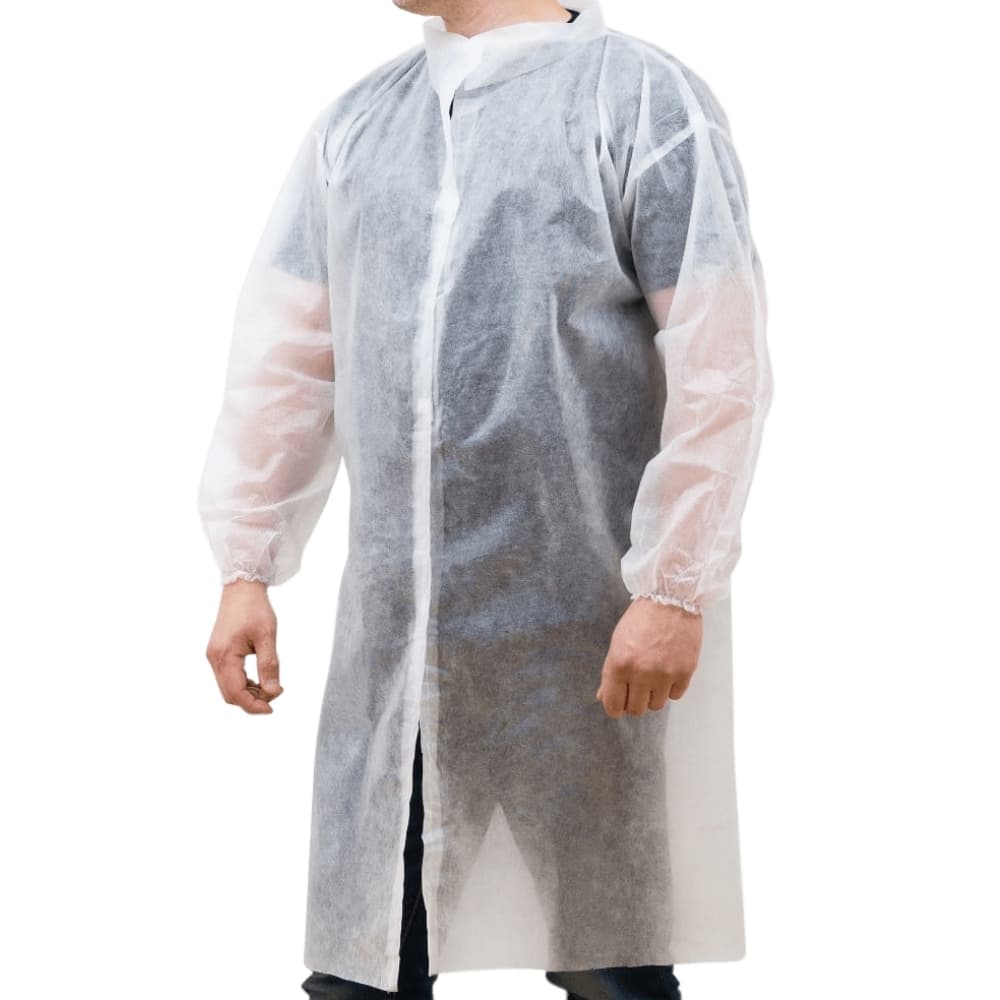
Every auditor, contractor and supplier rep arrives in outdoor clothing that has been in a car, a warehouse and possibly another plant that morning. A disposable visitor gown is the control applied at the boundary: a clean single-use layer put on at the entrance and discarded on the way out, with no laundering and no reused garment sitting on a hook between visits. The specification that matters here is speed and simplicity, because you are gowning people who have never worn one before — a front closure they can work out unaided, elastic cuffs that keep sleeves clear of equipment, and enough stock at the door that nobody is waved through because the box is empty.
The disposable lab coat: the same garment, another name
Buyers searching for disposable lab coats and buyers searching for visitor gowns are usually looking at the same item: a sleeved non-woven coat with a front closure and elastic cuffs. The name follows the setting rather than the product — it is a lab coat in a QA laboratory, a gown at a plant entrance, a frock in some catering operations. What changes with the setting is wear time, and that is worth specifying honestly. A garment worn for a twenty-minute inspection can be as light as the fabric allows — 20 g/m² is enough — while one worn by laboratory or QA staff for a full shift is better specified at 30 g/m², because a light coat worn all day tears at the shoulders and gets replaced twice as often as budgeted.
Non-woven coveralls: when partial cover is not enough
A non-woven coverall is the answer when the whole body needs a barrier rather than the front of it. Ours are 30 GSM non-woven spunbond with a full front zip, covering torso, arms and legs in a single garment. In food processing that suits high-care production zones, deep-clean and washdown work, and contractor access to areas where exposed clothing is a real risk to product. The trade-off is comfort and cost: a coverall is warmer, slower to put on and more expensive per unit than a gown, so issuing one where a gown would do wastes money and quietly reduces compliance, because people avoid garments that are uncomfortable to work in.
Choosing by exposure, not by job title
A simple mapping covers most plants:
- Visitors, auditors and short plant tours: light non-woven gown, kept stocked at the entrance.
- QA, laboratory and inspection staff on shift: same garment in a heavier weight, as a disposable lab coat.
- High-care production and deep-clean: full-body coverall with a front zip.
- Contractors working on equipment in a production zone: coverall, plus hair nets and shoe covers.
- Wet-line operators: neither — an apron and sleeve covers are the right garments for liquid.
Weight, closure and sizing
Three details decide whether a body garment works in practice. Fabric weight, given in GSM, sets the balance between comfort and durability — lighter fabric is cooler and cheaper, heavier fabric survives a full shift and repeated movement. The closure decides how fast gowning goes: a hook-and-loop or press closure is quicker for visitor throughput, while a full-length zip is the right choice on a coverall that has to stay closed. Sizing is the one most often skipped, and it causes the most problems — a coverall too tight to crouch in splits at the seams, and a gown that swamps the wearer catches on machinery. Order a size spread rather than a single size and let the gowning station match the person. If you are setting up or reviewing gowning for visitors, QA and high-care areas, we can help you specify the right garment and weight for each and keep resupply consistent.
Frequently asked questions
- What is the difference between a disposable gown and a coverall?
- A gown gives partial cover — it goes over the front and sides of clothing with sleeves, and typically reaches the knee. A coverall is a single closed garment covering torso, arms and legs. Use a gown for entry, visits and QA work; use a coverall where high-care zones or deep-clean tasks call for full-body cover.
- Is a visitor gown the same as a disposable lab coat?
- In most cases yes. Both are sleeved non-woven garments with a front closure and elastic cuffs, and the name follows the setting rather than the product. The practical difference is wear time: choose a heavier weight where staff wear it for a full shift rather than for a short visit.
- What weight non-woven coverall is right for food processing?
- Around 30 GSM suits most food-processing use — breathable enough to wear through a working period while giving all-over cover. Lighter fabric is only sensible for brief entry, and heavier weights are worth specifying where the garment takes repeated movement or contact.
Related products
- Foot Protection
Non-woven Shoe Covers
Breathable non-woven disposable shoe covers for dry food processing and packaging zones — bulk supply from a manufacturer and exporter.
View product → - Body Protection
Disposable Visitor Gowns
Non-woven visitor gowns with velcro front and elastic cuffs for food processing plants — also used as a lab-coat-style disposable coat for staff and QA areas.
View product → - Body Protection
Disposable Coveralls
Non-woven coveralls with front zipper closure — full-body contamination barrier for food processing, packaging and production zones.
View product →
Need disposable PPE for your facility?
Send us your requirement and we'll get back to you with a quote.
Request a Quote